 Add to Chrome
 Add to Firefox
 Add to Edge
Forest-Guided Semantic Transport for Label-Supervised Manifold Alignment
Feb 01, 2026
Label-supervised manifold alignment bridges the gap between unsupervised and correspondence-based paradigms by leveraging shared label information to align multimodal datasets. Still, most existing methods rely on Euclidean geometry to model intra-domain relationships. This approach can fail when features are only weakly related to the task of interest, leading to noisy, semantically misleading structure and degraded alignment quality. To address this limitation, we introduce FoSTA (Forest-guided Semantic Transport Alignment), a scalable alignment framework that leverages forest-induced geometry to denoise intra-domain structure and recover task-relevant manifolds prior to alignment. FoSTA builds semantic representations directly from label-informed forest affinities and aligns them via fast, hierarchical semantic transport, capturing meaningful cross-domain relationships. Extensive comparisons with established baselines demonstrate that FoSTA improves correspondence recovery and label transfer on synthetic benchmarks and delivers strong performance in practical single-cell applications, including batch correction and biological conservation.

Random Forest Autoencoders for Guided Representation Learning
Feb 18, 2025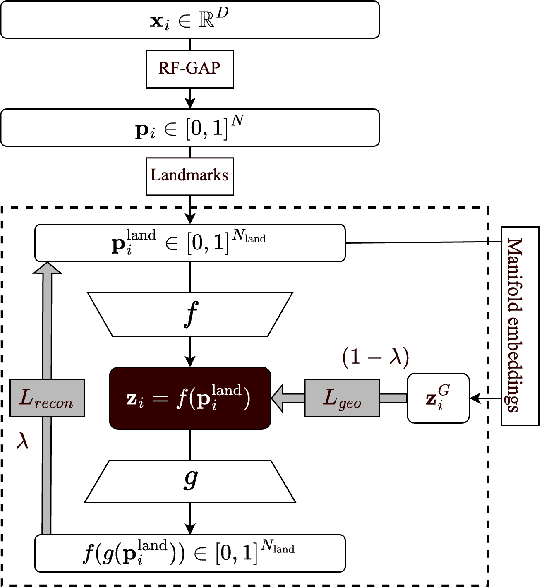
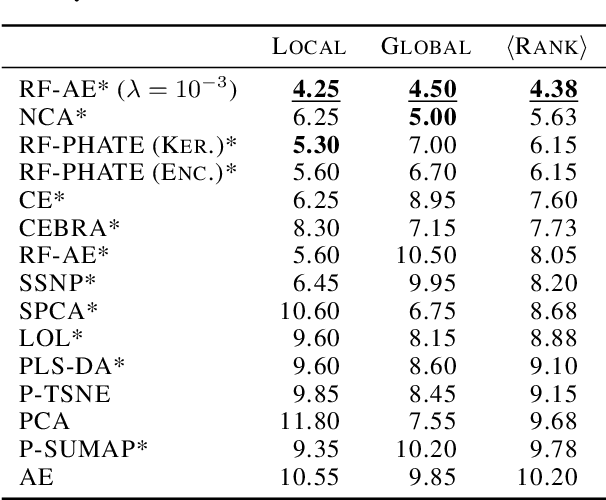
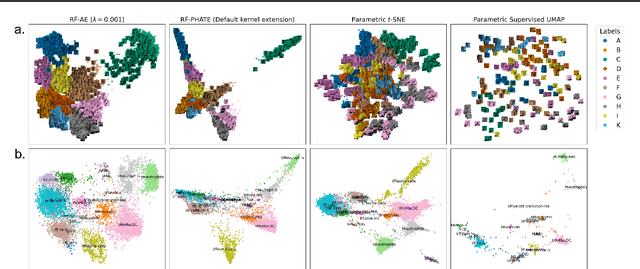
Decades of research have produced robust methods for unsupervised data visualization, yet supervised visualization$\unicode{x2013}$where expert labels guide representations$\unicode{x2013}$remains underexplored, as most supervised approaches prioritize classification over visualization. Recently, RF-PHATE, a diffusion-based manifold learning method leveraging random forests and information geometry, marked significant progress in supervised visualization. However, its lack of an explicit mapping function limits scalability and prevents application to unseen data, posing challenges for large datasets and label-scarce scenarios. To overcome these limitations, we introduce Random Forest Autoencoders (RF-AE), a neural network-based framework for out-of-sample kernel extension that combines the flexibility of autoencoders with the supervised learning strengths of random forests and the geometry captured by RF-PHATE. RF-AE enables efficient out-of-sample supervised visualization and outperforms existing methods, including RF-PHATE's standard kernel extension, in both accuracy and interpretability. Additionally, RF-AE is robust to the choice of hyper-parameters and generalizes to any kernel-based dimensionality reduction method.
Manifold Alignment with Label Information
Oct 31, 2022Multi-domain data is becoming increasingly common and presents both challenges and opportunities in the data science community. The integration of distinct data-views can be used for exploratory data analysis, and benefit downstream analysis including machine learning related tasks. With this in mind, we present a novel manifold alignment method called MALI (Manifold alignment with label information) that learns a correspondence between two distinct domains. MALI can be considered as belonging to a middle ground between the more commonly addressed semi-supervised manifold alignment problem with some known correspondences between the two domains, and the purely unsupervised case, where no known correspondences are provided. To do this, MALI learns the manifold structure in both domains via a diffusion process and then leverages discrete class labels to guide the alignment. By aligning two distinct domains, MALI recovers a pairing and a common representation that reveals related samples in both domains. Additionally, MALI can be used for the transfer learning problem known as domain adaptation. We show that MALI outperforms the current state-of-the-art manifold alignment methods across multiple datasets.